Thursday, April 29, 2010

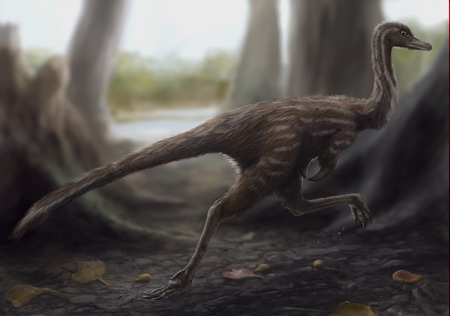
Similicaudipteryx


It's already a well-known fact that China is the proverbial 90's mall for palenotiologists: everyone wants to be there since all the cool stuff is there. One thing that proves this is the discovery of Similicaudipteryx, annoucned this week in the journal Nature.

The fossils show feathers and how they changed as Similicaudipteryx aged. A juvenile and an older specimen were both found in western Liaoning, in China. Both fossils are approximatly 125 million years old.
Modern birds have fluffy down that is primarily to keep them warm, and once they molt, they grow what is essentially adult feathers. Similicaudipteryx, on the other hand, the juveniles have a "middle stage" in which their feathers are somewhat quill-like, more like ribbons than true feathers, while adults have more modern feathers. The younger individual also has longer feathers on the tail, while the elder had longer feathers on the wings.
The reason for this type of "feather evolution" isn't known why, but the different feather lengths for the different ages may be due to different needs: younger individuals would have a higher need to escape, while older individuals are more concerned about hunting and mating.

http://cosmiclog.msnbc.msn.com/archive/2010/04/28/2288537.aspx

Mastodons

The American mastodon was the last living member of the mastodon family, and lived around the Great Lakes, among many other places. The range was from Alaska to Honduras. The name came from it’s distinguishing feature, it’s teeth. Unlike the wooly mammoth, the mastodon’s teeth have nipple-like projections on the molars in order to suit it’s diet of leaves.
Paleontology Prime

Check out the album for pictures of a mastodon and on theories of their extinction.

The mastodons lived from 3.7 million years ago to 10,000 B.C., and there’s debate as to why they went extinct. One theory is that humans caused the extinction through hunting. Before man came to the continent, the only thing that could threaten adult-size mastodons would be American cave lions. The natural balance of predator and prey kept the numbers of both species in equilibrium. With humans present, suddenly more “predators” were killing mastodons and the balance was upset, even if only a few animals were killed each year.
Another theory was climate change. During the final few thousand years of the mastodon, the glacial ice sheet in North America was retreating. With the ice mass gone, weather changed. Large glaciers pull moisture out of the air and change natural weather patterns—the ice could be over a mile tall. With different temperatures and moistures, different plants bloomed. In order to still have the food supply they were adapted to, they had to move north along with the glacier. Eventually, there wasn’t enough food to keep their populations afloat, and they died out.
A third theory is that the lakes themselves locked them in the land that would become America, and that they died out when the food supply left. The Great Lakes formed when the retreating ice sheets pulled against the ground, and left giant gouges in the Earth. When they filled in, they became the lakes, and a very large and effective natural barrier. Very few mastodon fossils have been found north of the lakes, which gives credence to this theory.
What most likely happened is that all three of these theories described what happened. Ice sheets did retreat, whether did change, and humans did appear, and a mix of almost likely took them out.

Monday, April 19, 2010

Dino Fight

The Velciraptor, famous for wanting to kill small children in Jurassic Park, is known to be a fearsome predator. Recent fossil evidence, though, also suggests that sometimes they weren’t lucky enough to catch a break, and that they had to resort to scavenging.

Paleontologists dug up a Protoceratops fossil and two teeth from a carnivore in Mongolia, the home to the Velciraptor—not Montana as Jurassic Park says. Protoceratops is in the same family as the more familiar Triceratops, and is much smaller and lacks the trademark horns, but has a similar beak and neck frill.

The found teeth were matched to a Velociraptor, or a fellow raptor of similar size. The Protoceratops had scratches on the jaw and skull from the found teeth, which suggest scavenging. "This pattern is also seen in living carnivores — when faced with a large body, they start on the belly and hindlegs and the head is nearly always the last to go. Here the skull and jaws are the bones with the marks on and thus most likely to be the bits left over, not those first taken on,” said David Hone, a paleontologist at the Institute of Vertebrate Paleontology and Paleoanthropology of China in Beijing.

The picture with this article is of a famous fossil from another Protoceratops v Velociraptor meeting. Nicknamed “fighting dinosaurs,” the fossil depicts the two beasts fighting. Discovery Channel had a special on their series “Dinosaur Planet” in which the fight was recreated, and the fossil was recreated by two CGI dinosaurs fighting in a desert, and a collapse of a dune buried them both, thus creating a situation in which the fossil can be formed in such a way.

http://www.foxnews.com/scitech/2010/04/19/velociraptor-scavenging-larger-dinosaur/

Monday, March 29, 2010

Xixianykus zhangi


A new single-clawed dinosaur has been discovered in China, says the journal Zootaxa on Monday. Xing Xu, researcher from the Chinese Academy of Sciences Institute of Vertebrate Paleontology, lead writing the article that described the running capability of Xixianykus zhangi.

“The limb proportions of Xixianykus are among the most extreme ever recorded for a theropod dinosaur,” one of the researchers said, stating that this dinosaur was built for speed. It stood only 20 inches tall, and the fossil itself weighed less than a kilogram. The shorter length of the thigh bone compared to other similar dinosaurs hinted that it could have dug for termites and other insects for food. It was believed to live around 85 million years ago.

The fossil was unearthed in the Upper Cretaceous Majiacun Formation of Xixia County in the Henan province, in central China. The area normally bares fossilized eggs, accounting for a third of all such fossils in the world. Actual dinosaurs, though, are a rarer find.

http://content.usatoday.com/communities/sciencefair/post/2010/03/road-runner-dinosaur-revealed-in-china/1

http://www.chinadaily.com.cn/china/2010-03/29/content_9658733.htm

Wednesday, March 24, 2010

Blame the Plates!

Now that we know how the dinosaurs died out, focus is being put on how dinosaurs ended up on the top of the food chain.

Proceedings of the National Academy of Sciences published this week new research on the events that may have been a blessing for the ‘saurs. Around 206 million years ago was the end-Triassic extinction event, which wiped out approximately 76% of all species on Earth, though the event isn’t as widely known as the KT extinction that killed the dinosaurs. This event also has less theories as to why it happened.

The new research in Proceedings suggests that volcanic activity was the culprit. The North American and African plates pulled away from each other, breaking apart Pangaea and allowing magma to reach the surface. With it came carbon-12, an isotope normally released with volcanoes. Chemical plant fossils from this time period have higher than normal carbon-12. This gas, along with other greenhouse gases, altered the Earth’s temperatures. Other chemicals released from the activity altered the pH of the oceans and of rain, which lead to the demise of sea life and plants.

The biggest casualty of the event were the crurotarsans, which were alligator-like vertebrates. Most of them went extinct because of this event, though the dinosaurs did not. Why one and not the other survived is unknown, but after the end-Triassic extinction, there was little competition for resources, and dinosaurs quickly filled in the gaps left behind.

Most dinosaurs of the Triassic period were small, such as the dimetrodon, but the Jurassic period was when they took full advantage of their new supply of resources. Allosaurus, diplodocus, and archaeopteryx were all representative dinosaurs of the Jurassic.

http://www.ucmp.berkeley.edu/mesozoic/triassic/triassic.html

http://www.britannica.com/EBchecked/topic/1523109/end-Triassic-extinction

http://www.livescience.com/animals/how-dinosaurs-ruled-earth-100322.html

http://www.wired.com/wiredscience/tag/crurotarsans/

Wednesday, March 10, 2010

It was the Asteroid!

The jury’s finally back: it was indeed an asteroid that killed the dinosaurs.

How the dinosaurs went extinct 65 million years at the end of the Cretaceous period has been up to debate for decades, though many paleontologists agreed that a massive asteroid impact could have done it. Alternate theories were climate change, plant evolution, volcanic activity, disease, and mammals evolving fast enough to be a threat to the dinosaurs.

The asteroid theory held the most plausibility of all the theories—and was the most widely accepted—because of evidence that showed that there was such an event around 65 million years ago. On the Yucatan Peninsula in Mexico, there’s the Chicxulub crater, which is at least 110 miles wide, meaning the asteroid that did the deed had to be greater than six miles long.

What paleontologists have found and used for evidence that the Chicxulub impact was the cause for the extinction was the KT boundary. The layer of sediment from 65 million years ago—coinciding with the impact and the extinction—contains an astronomically high level of iridium, a heavy metallic element that is rarely found on Earth, but commonly in asteroids. Luis Alvarez and his son Walter found the KT boundary and created the theory in 1980 that an asteroid caused the extinction.

About 40 scientists from around the world met to discuss the event. They published an article in Science on Thursday stating that it was the asteroid at Chicxulub that caused the massive extinction. The Yucatan region was already sulfur-rich, and the impact kicked billions of tons of the element into the atmosphere. That along with other debris from impact blocked out the sun and killed off plant life. The shockwave knocked down trees, and the heat of the asteroid entering the atmosphere set forests on fire even before impact. The resulting explosion was a billion times more powerful than the bomb that was dropped on Hiroshima, Japan.

The fact that any life could survive this event seems miraculous. Mammals at the time were more like mice and shrews than anything big enough to be of any concern to a dinosaur, so having a much smaller need for food and being able to hide underground allowed our ancestors to live long enough to claim the Earth in their name in later geologic periods.

For more information:

http://www.csmonitor.com/From-the-news-wires/2010/0309/What-s-to-blame-for-dinosaur-extinction-Asteroids

http://www.washingtonpost.com/wp-dyn/content/article/2010/03/09/AR2010030903428.html

http://en.wikipedia.org/wiki/Kt_boundary

http://en.wikipedia.org/wiki/Chicxulub_crater